
ViralDashboard social media management dashboard with AI content planning, multi-platform publishing, unified inbox and analytics tools.

Viral Dashboard Review (2026): Does It Really Work?

Every social media manager has lived the same Monday: a content calendar in one tab, a design tool in another, a scheduler in a third, an inbox in a fourth, and a report that somehow has to come out of all of it. Viral Dashboard promises to collapse that mess into one login, with AI doing the heavy lifting.

It’s an appealing pitch. But “all-in-one” is one of the most overused phrases in software, so the real question is simple: does Viral Dashboard really work? I went through its pricing, refund terms, feature list and customer reviews, and a few details don’t line up the way the marketing suggests.

Managing social media can quickly turn into a full-time job. Between planning content, designing posts, replying to comments, publishing across platforms and tracking performance, even a small business can struggle to stay consistent.

That is the problem Viral Dashboard claims to solve. Its upcoming Live Reveal promises to demonstrate how one dashboard can plan 30 days of content, create posts, distribute them across 20 platforms, respond to comments and generate reports.

It sounds convenient—but does the software deliver enough value to justify paying for it?In this Viral Dashboard review, we examine the advertised features, published subscription plans, AI credit system, platform-support claims and customer feedback. We also highlight important questions to resolve before buying, so you can make a decision based on more than an impressive sales presentation.

What Is Viral Dashboard?

Viral Dashboard is an AI-assisted social media management platform developed by Webliska Technologies. It is designed to help creators, businesses and agencies manage multiple social accounts from one interface.

Rather than switching between different tools for scheduling, content creation, engagement and analytics, users can access several workflows through a single dashboard.

According to its official website, the platform includes features such as:

  1. Content planning: Organize upcoming posts with a content calendar and AI-generated strategies.
  2. Publishing and scheduling: Compose, schedule and manage social media posts.
  3. Bulk scheduling: Import up to 500 posts through CSV files, according to the product information.
  4. Engagement management: Use a unified inbox and AI-assisted replies.
  5. Creative Studio: Access AI-assisted design and content creation tools.
  6. Analytics and reports: Review performance and create reports, including white-label PDFs.
  7. Automation: Configure selected workflows and feed-based content processes.
  8. Link-in-bio pages: Create a destination page for links shared through social profiles.

The range of features is appealing, particularly for users managing multiple brands. However, having many tools in one dashboard does not automatically make a platform reliable, easy to use or cost-effective.

Those questions require closer examination.

How Does Viral Dashboard Work?

ViralDashboard is designed to bring the main stages of social media management into one workflow.

1. Connect your social accounts

You begin by connecting the social profiles you want to manage. The available features depend on the platform, account type and integration supported.

Once connected, you can organize your accounts and prepare content for publication.

2. Plan your content

The visual content calendar helps you organize posts across your publishing schedule. You can plan upcoming campaigns, manage drafts and coordinate content across different accounts.

For businesses that struggle with consistency, having a central calendar can make it easier to see what needs to be published and when.

3. Create captions and graphics

AI-assisted tools can help generate captions, suggest content ideas and create visual assets. These features can reduce the time spent starting from a blank page.

However, AI-generated content should still be reviewed. A caption that sounds natural on LinkedIn may not suit Instagram or TikTok, and generic graphics may not reflect your brand.

4. Schedule and publish posts

After reviewing your content, you can schedule posts for supported platforms. The goal is to reduce repetitive work and avoid logging into multiple accounts throughout the day.

5. Monitor engagement and performance

The platform also advertises engagement management and reporting features. These can help businesses review conversations and assess how their content performs.

The important distinction is that automation can simplify publishing, but it cannot guarantee reach, engagement or sales. Those outcomes still depend on your content, audience, offer and marketing strategy.

Viral Dashboard Features: What Stands Out?

Viral Dashboard Features

Several features could make ViralDashboard useful, particularly for people managing multiple brands.

AI-assisted content planning

Planning a month’s worth of posts can take considerable time. ViralDashboard’s content strategy tools aim to make this easier by generating dated content plans and helping users develop ideas.This could be useful when you manage multiple clients or need to maintain a regular posting schedule.

The limitation is that AI-generated calendars may still need substantial editing. A local business, an ecommerce brand and a personal finance creator should not all publish the same style of content.

Multi-platform publishing

The platform’s website promotes publishing across multiple social networks from one calendar.This can be valuable when you repurpose content for different channels. For example, a business might adapt an educational post for LinkedIn, create a shorter version for Instagram and publish a video on YouTube.

However, supported features vary by platform. Check the official integrations page to confirm whether your required accounts support direct publishing, engagement management and analytics.

Unified inbox and AI replies

Responding to comments and messages can become difficult when conversations are spread across several accounts.A unified inbox may help centralize supported interactions. AI-assisted replies can also provide a starting point for routine responses.

For customer complaints, sensitive conversations or sales enquiries, human review remains important. Automated replies should not replace thoughtful communication.

Analytics and client reporting

Viral Dashboard advertises analytics dashboards and branded reports. These features may be especially helpful for freelancers and agencies that need to communicate results to clients.

Before relying on the reports, check which metrics are available for each connected platform and whether the data is updated at the frequency your workflow requires.

Viral Dashboard Pricing: How Much Does It Cost?

Viral Dashboard publishes subscription pricing on its official pricing page. The following figures reflect the plans currently displayed on the website at the time of writing.

PlanMonthly billingAnnual billing, effective monthly price
Creator$19/month$16/month
Pro$49/month$41/month
Business$89/month$74/month
Agency$149/month$124/month
White-Label$299/month$249/month

The final annual payment is charged according to the annual billing terms, so check the checkout total rather than treating the effective monthly figure as the amount due immediately.

The official site also advertises a free trial. Its product page specifies a 14-day trial that requires a payment card. Confirm the cancellation deadline and applicable conditions before starting.

Which plan should you choose?

The right plan depends on how many accounts you manage and which features you need.

  • Creator: Consider this if you manage a small number of accounts and primarily need content planning and publishing.
  • Pro: May suit users who need greater capacity and more advanced workflow options.
  • Business: Worth evaluating for growing teams managing several brands.
  • Agency: Designed for agencies handling multiple client accounts.
  • White-Label: Relevant to businesses that want to offer the platform under their own branding.

Do not choose a plan simply because it offers the highest number of profiles. Check user limits, brand limits, scheduled-post allowances and AI credits before deciding.

The AI Credit System: A Cost You Should Understand

Viral Dashboard uses credits for certain AI-powered actions. Its published pricing information lists the following examples:

AI actionPublished credit cost
30-day content plan700 credits
Caption with three variations15 credits
Standard AI-generated image240 credits
AI layout suggestion28 credits

Consider a hypothetical month in which you generate one content plan, request three caption variations for 30 posts and create one AI image for every post.

The estimated requirement would be:

  • Content plan: 700 credits
  • Caption generation: 450 credits
  • Image generation: 7,200 credits
  • Total: 8,350 credits

This is an illustrative calculation using the published figures, not an estimate of what every customer will spend.Your actual usage could be lower if you reuse existing graphics, write some captions yourself or generate images only when necessary.Viral Dashboard also offers additional credit packs. Check the current pricing page for the latest allowances and top-up prices, as these can affect the total cost of using the platform.

My recommendation is to estimate your monthly content volume before subscribing. A plan that looks affordable at first may become less attractive if your workflow depends heavily on AI-generated images.

Does It Really Support 20 Platforms?

ViralDashboard’s marketing mentions 20 platforms. The pricing FAQ, however, names 11: Facebook, Instagram, X, LinkedIn, TikTok, YouTube, Pinterest, Google Business Profile, Threads, Bluesky and Mastodon.

The other nine in the marketing material are Reddit, Tumblr, Telegram, WordPress, WooCommerce, Shopify, Vimeo, VK and Medium. Several are blogging or store platforms, so they may connect through integrations or RSS rather than native social posting. That’s plausible and not necessarily a flaw. But “20 platforms” and “11 platforms” are different promises, so if one of those nine matters to you, ask support how it works before paying.

Is Viral Dashboard Legit? What Customers Say

This is where the picture gets complicated. On Trustpilot, ViralDashboard holds a 1.7 out of 5 from 36 reviews. About 89% are one-star and 11% are five-star, with essentially nothing in between.

The Complaints

  • Refunds: several reviewers say requests stalled or they were offered other products instead of money back
  • Upsells: some describe extra paid add-ons after buying a one-time “lifetime” offer
  • Functionality and access: login problems and features that didn’t work as advertised

The Praise

Positive reviewers describe a useful multi-brand scheduler. One reports using it for over four years on a one-time license across many brands, and others praise responsive support.

How to Read This Fairly

Thirty-six reviews is a small, unverified sample, and unhappy customers tend to review more often. Many complaints concern older lifetime-style offers, and your experience may depend on which offer you buy. Still, a near-perfect split between love and hate usually means results hinge on the details. The company also hasn’t publicly replied to the negative reviews, which doesn’t help its case.

The Refund Policy Mismatch

This one is easy to miss. The refund policy page states a 14-day money-back window, while the pricing page promises 30 days, no questions asked. The policy also excludes consumed AI credits and add-ons, and monthly subscriptions aren’t pro-rated.

I’m not suggesting anything improper, but two pages disagreeing is a good reason to screenshot the exact terms at checkout. If you buy through a third-party marketplace, its refund rules may apply instead.

Viral Dashboard vs. Buffer, Hootsuite and Sprout Social
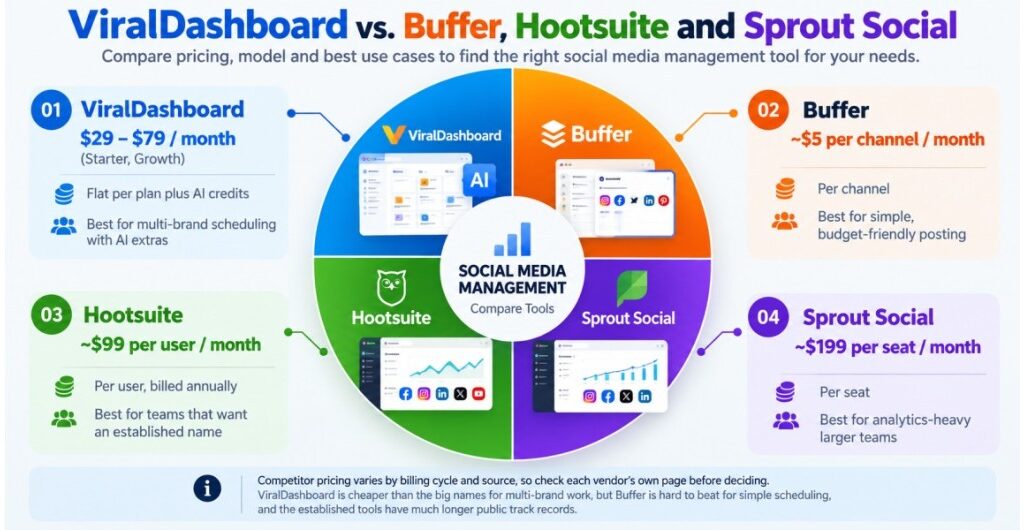
ToolTypical Entry PricingPricing ModelBest For
ViralDashboard$29 to $79 per month (Starter, Growth)Flat per plan plus AI creditsMulti-brand scheduling with AI extras
BufferAbout $5 per channel per monthPer channelSimple, budget-friendly posting
HootsuiteAbout $99 per user per monthPer user, billed annuallyTeams that want an established name
Sprout SocialAbout $199 per seat per monthPer seatAnalytics-heavy larger teams

Competitor pricing varies by billing cycle and source, as this comparison and this one show, so check each vendor’s own page before deciding. One small flag: ViralDashboard’s comparison table lists Sprout Standard at $249, while most independent listings show about $199.

The fair read: ViralDashboard is cheaper than the big names on paper for multi-brand work. But Buffer is hard to beat for simple scheduling, and the established tools have much longer public track records.

Key Insights: Who Viral Dashboard Works For

It may work well if you:

  1. Manage several small brands and want one dashboard
  2. Are comfortable starting on the free plan before paying
  3. Want AI drafting and design help and will track your credits

Think twice if you:

  1. Need proven reliability for paying client work right away
  2. Are buying mainly because of income promises (the company’s own pages state there’s no guarantee of income)
  3. Can’t confirm the refund terms before paying

Pros and Cons of Viral Dashboard

Pros

  1. Combines several social media management functions in one interface.
  2. Offers AI-assisted captions and content planning.
  3. Provides a visual content calendar and scheduling features.
  4. Includes engagement and reporting tools.
  5. Offers plans for different types of users and agencies.

Cons

  1. AI credit usage can increase the overall cost.
  2. Platform features and integrations need to be checked individually.
  3. Public customer reviews include significant complaints about functionality and refunds.
  4. AI-generated content still requires human review.
  5. A large number of features may be unnecessary for users with simple scheduling needs.

Who Should Use Viral Dashboard?

Viral Dashboard may be worth considering if you manage multiple social accounts, create content for clients or want scheduling, AI assistance and reporting in one place.

It may be particularly useful for freelancers and small agencies that spend too much time switching between accounts and preparing routine reports.

However, it may not be the best fit if you need only basic scheduling, depend on a platform with a proven track record, or cannot risk disruptions to client campaigns.

If you’re considering it, start by listing your essential features. Confirm that the platform supports them, estimate your AI credit usage and test the workflow before relying on it for important business tasks.

Final Verdict: Does Viral Dashboard Really Work?

Viral Dashboard offers a broad collection of social media management features, including content scheduling, AI-assisted creation, engagement management and reporting. These capabilities could save time for creators, businesses and agencies managing multiple accounts.

However, the available evidence is not sufficient to confirm that every advertised feature works reliably for every user. Customer feedback is mixed, and the potential cost of AI credits deserves careful consideration.

We would not recommend buying solely because a platform promises to automate an entire month of social media work. Instead, verify its integrations, test the features you need, calculate the likely total cost and read the refund terms.

If ViralDashboard handles your real workflow effectively, it could become a useful part of your marketing toolkit. If you only need straightforward scheduling, compare simpler alternatives before spending more.

Ready to Explore Viral Dashboard?

Visit the official Viral Dashboard website to review its features, current plans and trial conditions. Make sure you understand the subscription terms and any additional AI credit costs before signing up.

Have you used ViralDashboard, or are you considering it for your business? Share your experience in the comments to help other readers make an informed decision.
Audifort hearing supplement review exploring potential side effects, FDA approval status and safety considerations.

Audifort Side Effects & FDA Approval (2026): Is It Safe?

Introduction: What Should You Know About Audifort Side Effects?

When a supplement promises to support hearing health, mental clarity and overall well-being, it is natural to wonder whether the potential benefits outweigh the risks.

Audifort is a liquid dietary supplement marketed for hearing and brain wellness. Its promotional material highlights a multi-ingredient formula and suggests that it may support people concerned about ringing in their ears, hearing changes and related issues.But before purchasing any health supplement, two important questions deserve attention: What are the possible Audifort side effects, and is Audifort FDA approved?

These questions matter because a product being sold online does not automatically mean its advertised benefits have been clinically established or that its safety has been independently confirmed.In this guide, we examine Audifort’s advertised ingredients, the limitations of the available product-specific safety evidence, FDA regulations for dietary supplements, and the precautions worth considering before use.

If you are researching Audifort before buying it, this article will help you understand what is known, what remains uncertain, and which questions you should ask.

Is Audifort FDA Approved?

This is one of the most important questions to address.The U.S. Food and Drug Administration (FDA) regulates dietary supplements, but its regulatory approach differs from the approval process for prescription medicines.

According to the FDA’s official guidance on dietary supplements, the agency does not approve dietary supplements for safety and effectiveness before they are marketed.Consequently, a supplement can be legally sold without having undergone the same premarket clinical evaluation required for a new prescription medicine.

What Does This Mean for Audifort?

Audifort is marketed as a dietary supplement. Therefore, consumers should not assume that the FDA has independently verified its advertised hearing benefits or established its effectiveness through clinical trials.

There is an important distinction between the following terms:

TermWhat it actually means
FDA approvedThe FDA has formally approved a product for a particular use under the applicable regulatory process.
FDA registeredA facility or entity has completed a relevant registration process. Registration does not mean the product itself has been approved.
Manufactured under applicable quality requirementsThe manufacturer is subject to relevant manufacturing and quality requirements. This does not establish clinical effectiveness.
Clinically provenAppropriate clinical evidence supports a specific claim about a product or treatment. The strength of that evidence depends on the quality of the studies.

These terms are not interchangeable.

Our finding: We could not verify product-specific FDA approval for Audifort from the information reviewed. More importantly, dietary supplements generally do not receive FDA approval for safety and effectiveness before marketing.

For additional information, read the FDA’s explanation of how dietary supplements are regulated.

What Are the Possible Audifort Side Effects?

One challenge when researching Audifort side effects is distinguishing documented adverse reactions from general precautions associated with dietary supplements.

The product information reviewed for this article does not provide sufficient independently verified, product-specific clinical evidence to establish a reliable list of Audifort side effects or determine how frequently they occur.

That does not prove the supplement is free from side effects. It means consumers should avoid treating the absence of documented information as proof of safety.

1. Digestive Discomfort

Some dietary supplements can cause digestive symptoms, depending on their ingredients, concentrations and the person taking them.However, we cannot confidently identify digestive discomfort as a confirmed or common Audifort side effect without reliable product-specific evidence.

If you experience persistent nausea, abdominal discomfort, vomiting or other concerning symptoms after taking a supplement, stop using it and seek appropriate medical advice.

2. Allergic Reactions or Sensitivities

Multi-ingredient supplements may contain botanical extracts or other substances that are unsuitable for certain individuals.Review the complete ingredient label before use, particularly if you have known allergies or sensitivities.

Seek emergency medical assistance if you experience symptoms of a serious allergic reaction, such as difficulty breathing or swelling of the tongue or throat.

3. Possible Medication Interactions

Herbal ingredients and other dietary supplement components can interact with prescription medicines or other supplements.

The potential interaction depends on the exact ingredients, their amounts and the medicines involved.The FDA advises consumers to consult a healthcare professional before using dietary supplements when appropriate. Its guidance on mixing medicines and dietary supplements explains why these interactions deserve attention.

4. Unknown Long-Term Effects

A supplement’s long-term safety cannot be established simply by looking at its ingredient list.Reliable assessment requires information about the complete formula, ingredient quantities, duration of use and relevant safety evidence.If you cannot obtain a complete and clear product label, consider discussing the uncertainty with a qualified healthcare professional before deciding whether to use it.

Important: These are general supplement safety considerations, not a list of confirmed Audifort adverse effects. Product-specific risks and their frequency remain uncertain based on the evidence identified for this review.

What Ingredients Does Audifort Contain?

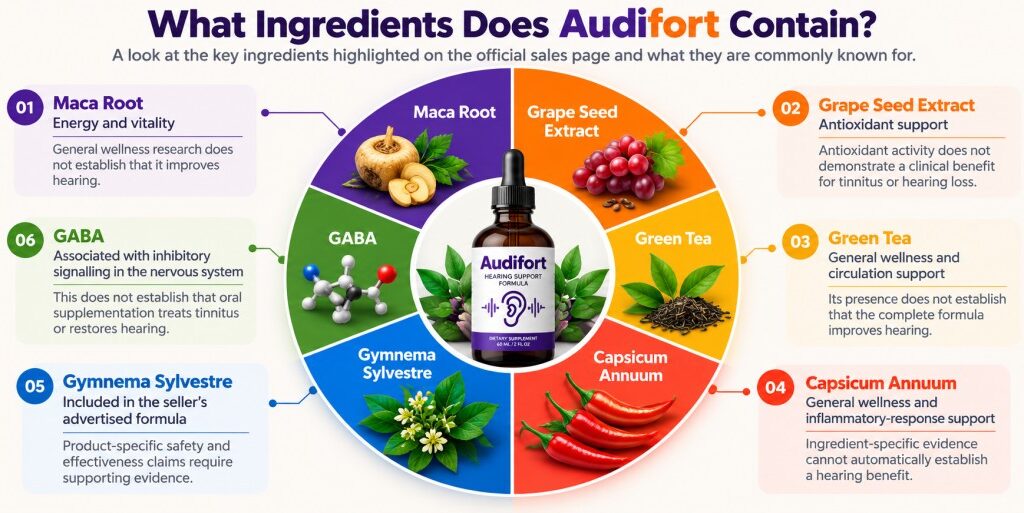
According to the product information examined in our previous Audifort review, the seller highlights multiple ingredients, including maca root, grape seed extract, green tea, capsicum, Gymnema sylvestre and GABA.

The precise composition and quantity of every ingredient should be checked against the product’s current Supplement Facts label.

Ingredients Does Audifort
IngredientAdvertised or commonly discussed purposeWhat consumers should know
Maca rootEnergy and vitalityGeneral wellness research does not establish that it improves hearing.
Grape seed extractAntioxidant supportAntioxidant activity does not demonstrate a clinical benefit for tinnitus or hearing loss.
Green teaGeneral wellness and circulation supportIts presence does not establish that the complete formula improves hearing.
Capsicum annuumGeneral wellness and inflammatory-response supportIngredient-specific evidence cannot automatically establish a hearing benefit.
Gymnema sylvestreIncluded in the seller’s advertised formulaProduct-specific safety and effectiveness claims require supporting evidence.
GABAAssociated with inhibitory signalling in the nervous systemThis does not establish that oral supplementation treats tinnitus or restores hearing.

This table summarizes the seller’s ingredient descriptions and general evidence limitations. It is not a complete ingredient label or a clinical assessment of Audifort.

Why the Complete Formula Matters

An ingredient may have been studied in laboratory experiments or human research, but that does not mean a finished supplement containing it will produce the same results.

Three factors are particularly important:

  1. Dosage: The quantity in the product must be compared with the amount studied in relevant research.
  2. Formula: Ingredients can behave differently when combined, and evidence for one ingredient does not establish the effectiveness of the complete mixture.
  3. Clinical evidence: Research needs to measure meaningful outcomes in people, using appropriate methods.

Before buying Audifort, examine the full label and look for ingredient quantities, serving instructions and manufacturer information.

If these details are unavailable or unclear, evaluating the product’s potential benefits and risks becomes more difficult.

Can Audifort Interact With Medications?

This is a relevant question for anyone considering a multi-ingredient supplement.

Some dietary supplement ingredients can affect how medicines work, alter their effects or increase the risk of adverse reactions.

The possibility of an interaction depends on the actual formula and the individual’s circumstances. Without a verified, complete ingredient list and appropriate interaction data, it would be misleading to declare Audifort compatible with every medication.

Before using Audifort, speak with a doctor or pharmacist if you:

  1. Take prescription medicines regularly.
  2. Use other dietary supplements or herbal products.
  3. Have an ongoing medical condition.
  4. Have a history of allergic reactions to supplements.
  5. Are pregnant, breastfeeding or considering using the product in these circumstances.

Bring the complete product label to the consultation so the healthcare professional can review the ingredients and amounts.

Do not stop prescribed medication or change its dosage to accommodate a supplement without professional guidance.

Is Audifort Safe to Take Every Day?

There is no reliable basis in the evidence reviewed here to establish a universally safe daily regimen for Audifort.

The appropriate decision depends on the product’s actual composition, its directions, the person’s health and any medications they take.

Before considering daily use, check the following:

1. Read the complete label. Confirm the serving size, ingredient amounts and recommended directions.

2. Check the manufacturer information. Look for identifiable manufacturer or distributor details and relevant quality information.

3. Review potential interactions. Ask a qualified healthcare professional whether the ingredients are appropriate for you.

4. Understand the evidence limitations. A seller’s suggested usage period does not prove that taking the supplement for that duration will improve hearing or remain safe for every user.

5. Monitor unexpected symptoms. Stop using the product and seek appropriate medical advice if you develop concerning symptoms.

A supplement should not replace medical evaluation when hearing problems or persistent tinnitus are present.

Does Audifort Help With Tinnitus or Hearing Loss?

Safety and effectiveness are different questions, but both matter when evaluating a hearing supplement.

Tinnitus is the perception of sounds such as ringing or buzzing without an external sound source. It can be associated with hearing loss, noise exposure, certain medications and other factors.

The National Institute on Deafness and Other Communication Disorders explains that vitamins, herbal extracts and dietary supplements marketed for tinnitus have not been proven effective for treating the condition.

Our previous Audifort review also found no verifiable published clinical trial demonstrating that Audifort itself improves hearing or reduces tinnitus. Pasted markdown

That distinction is important: evidence about an individual ingredient does not establish that the complete Audifort formula works.

What Are the Established Alternatives?

Depending on the cause and severity of the problem, appropriate hearing care may involve:

  • A professional hearing assessment.
  • Hearing aids for people with suitable hearing loss.
  • Sound-based approaches for managing tinnitus.
  • Cognitive behavioural therapy to reduce tinnitus-related distress.
  • Protection from excessive noise exposure.

The American Academy of Otolaryngology–Head and Neck Surgery Foundation’s tinnitus guidance discusses evidence-based management options and recommends against routinely using dietary supplements to treat tinnitus.

Seek urgent medical evaluation for sudden hearing loss. Do not wait to see whether a supplement helps, because prompt assessment can be important for treatment.

How Much Does Audifort Cost, and Is It Worth Buying?

The Audifort offer information reviewed for our previous article displayed packages priced at $158, $177 and $294, depending on the supply selected. The seller also advertised a 90-day money-back guarantee. These details may change, so check the current offer page for the latest prices, shipping charges and refund conditions. Pasted markdown

Price alone does not determine whether a supplement is worthwhile.

Before spending money, consider whether the advertised benefits are supported by reliable evidence, whether the complete formula is disclosed, and whether you have enough safety information to make an informed decision.

A larger package may reduce the advertised cost per bottle, but it does not make the supplement more effective or establish that long-term use is appropriate.

For a broader assessment of the seller’s claims, pricing and scientific evidence, see our complete Audifort review.

Frequently Asked Questions About Audifort

Is Audifort FDA approved?

We could not verify product-specific FDA approval from the information reviewed. More generally, the FDA does not approve dietary supplements for safety and effectiveness before they are marketed.

What are the side effects of Audifort?

The evidence reviewed does not establish a reliable list or frequency of Audifort-specific side effects. General supplement concerns include possible allergic reactions, ingredient-related adverse effects and medication interactions.

Is Audifort safe to take every day?

Its safety for every individual and for long-term daily use has not been established by the evidence reviewed. Check the full label and consult a qualified healthcare professional before use.

Can Audifort interact with prescription medicines?

Potential interactions depend on the actual ingredients, quantities and medicines involved. Ask a doctor or pharmacist to review the complete product label.

Does Audifort cure tinnitus?

There is no verifiable clinical evidence identified for this review establishing that Audifort cures tinnitus. The NIDCD also states that dietary supplements marketed for tinnitus have not been proven effective for treating the condition.

Is Audifort clinically proven?

We could not identify a verifiable published clinical trial establishing the effectiveness of Audifort itself for improving hearing or reducing tinnitus.

Final Verdict: Should You Be Concerned About Audifort Side Effects?

Audifort is marketed as a hearing and brain wellness supplement, but several important questions remain unanswered.

The evidence reviewed does not establish a reliable list of Audifort-specific side effects, prove that the product is safe for everyone, or demonstrate that it improves hearing or treats tinnitus.

Its FDA status also needs to be understood correctly: dietary supplements generally do not receive FDA approval for safety and effectiveness before marketing. This does not, by itself, establish that a particular supplement is unsafe; it means consumers should not interpret its availability as proof of FDA approval.

Before considering Audifort, review the complete ingredient label, check the seller’s current information, consider potential medication interactions and speak with a qualified healthcare professional when appropriate.

Most importantly, do not rely on a supplement instead of getting hearing symptoms assessed.

Final Thoughts

When evaluating a health product, the most useful questions are not simply whether it is popular or whether other customers report positive experiences. What matters is whether the claims are supported by reliable evidence, whether the risks are understood and whether the product is appropriate for the individual.

We hope this guide has helped clarify the questions surrounding Audifort side effects and FDA approval.

Want to examine the product’s claims in more detail? Read our Audifort Review (2026): Does Audifort Really Work? for a broader analysis of its advertised benefits, ingredients, clinical evidence and pricing.

You can also visit the Audifort offer page to check the seller’s current product information and terms. Review those details carefully before making a purchase.

This article is for informational purposes only and is not a substitute for professional medical advice, diagnosis or treatment.

Audifort hearing supplement bottle surrounded by botanical ingredients, ear and brain icons, and security symbols.

Audifort Review (2026): Does Audifort Really Work?

Search for Audifort and you’ll find hundreds of glowing reviews. Dig a little deeper and something strange happens: many of them read almost word for word alike, and a few are hosted on university and conference websites that have nothing to do with hearing health. One even asks whether Audifort “really works for weight loss.” It’s a hearing product.

So before you hand over $158 to $294, it’s worth asking the question those pages avoid: does Audifort really work, or is it just very well marketed? Here’s what the official order page says, what the clinical evidence says, and where the two don’t line up.

What Is Audifort?

Audifort is a liquid supplement promoted for hearing support and cognitive wellness. According to its official sales page, the formula contains more than 20 selected ingredients intended to support healthy hearing and general well-being.

The product’s marketing discusses several concerns, including ringing or buzzing in the ears, mental fog, memory, and age-related hearing concerns.

However, it’s important to distinguish between supporting general health and treating a medical condition. A supplement marketed for ear health has not necessarily been shown to reduce tinnitus, restore damaged hearing, or prevent hearing loss.

The U.S. Food and Drug Administration explains that dietary supplements are not approved for safety and effectiveness before marketing in the same way as prescription medicines. Manufacturers remain responsible for product safety, labeling, and ensuring that claims are lawful and truthful. (FDA guidance on dietary supplements)

That distinction matters when evaluating any supplement making health-related promises.

Audifort Ingredients: What’s Inside the Formula?

Audifort’s sales page highlights several ingredients. Understanding what these ingredients are—and what remains unproven—provides a better starting point than relying on promotional descriptions alone.

IngredientPurpose stated by the sellerWhat to consider
Maca rootEnergy and vitalityEvidence for general wellness does not establish a benefit for hearing loss.
Grape seed extractAntioxidant supportAntioxidant activity does not prove that a supplement improves hearing.
Green teaCirculation supportA proposed mechanism is not proof of a clinical hearing benefit.
Capsicum annuumHealthy inflammatory responseEvidence for a general biological effect does not establish effectiveness for tinnitus.
Gymnema sylvestreHearing supportProduct-specific clinical evidence is needed to substantiate this claim.
GABARelaxation supportA relaxation-related claim does not demonstrate that the ingredient treats tinnitus or restores hearing.

Source for the listed ingredients: Audifort’s product page. The benefit descriptions above distinguish the seller’s positioning from independently established clinical outcomes.

Why Ingredient Lists Can Be Misleading

An ingredient may have antioxidant properties, influence a biological process, or have been studied for a particular health outcome. That does not automatically mean a finished supplement containing it produces the advertised result.

Three things matter:

  1. Dosage: The amount used in a clinical study needs to be compared with the amount supplied by the product.
  2. Formula: Evidence for an individual ingredient cannot automatically be transferred to a mixture of more than 20 ingredients.
  3. Clinical outcomes: Improvements need to be measured in people using reliable methods, rather than inferred from laboratory findings or testimonials.

Before buying Audifort, check the complete Supplement Facts label, including the amounts per serving. If those amounts are unclear, it becomes difficult to assess whether the formula resembles the quantities studied in research.

Does Audifort Really Work? What the Evidence Says

Here’s the honest answer: there’s no published clinical trial showing that Audifort itself improves hearing or reduces tinnitus. The order page cites general research instead, and that’s not the same thing. But we can still look at what’s known about this entire category of product.

Hearing and Tinnitus Supplements Have a Weak Track Record

Several third-party reviews list ginkgo biloba as a key Audifort ingredient. I couldn’t confirm that from the official page text, which highlights different ingredients, so check the bottle label yourself. Either way, ginkgo is the most studied supplement for tinnitus, and the results are a useful reality check.

A Cochrane systematic review of four studies with 1,543 participants found no evidence that ginkgo biloba is effective for tinnitus as a primary complaint. The authors also noted a strong placebo effect in tinnitus management, which helps explain why anecdotal reviews can sound so convincing.

What Professional Guidelines Say

The American Academy of Otolaryngology–Head and Neck Surgery Foundation’s tinnitus guideline says clinicians should not recommend ginkgo biloba, melatonin, zinc, or other dietary supplements for persistent, bothersome tinnitus. Instead, it advises cognitive behavioral therapy for people whose tinnitus is distressing.

One more structural point: as an audiology resource explains, the FDA treats supplements as food, so manufacturers don’t have to prove their claims before selling. Regulators generally act after problems are reported.

The Order Page’s “Scientific References”

I read the reference list on the order page. Some entries are legitimate, such as a piece on animal research into tinnitus and the brain, and a review of B vitamins and brain function. But legitimate studies about the brain or individual nutrients don’t show that this specific formula works.

Two entries stood out: A Course in Miracles, a spiritual text, and a paper on medicinal plants used for gastrointestinal disorders in an Iranian region. Neither has anything to do with hearing. When a reference list pads itself like this, treat the other claims with extra skepticism.

What Research Says About Hearing Supplements

The National Institute on Deafness and Other Communication Disorders (NIDCD) explains that tinnitus can be associated with hearing loss, noise exposure, and certain medications, among other factors. It also states that commonly advertised vitamins, herbal extracts, and dietary supplements have not been proven effective for tinnitus.

A peer-reviewed clinical guideline on chronic tinnitus likewise recommends against dietary supplements as an established treatment because convincing evidence of efficacy is lacking. (Clinical guideline on chronic tinnitus)

The practical takeaway is straightforward: the presence of natural ingredients or a plausible biological explanation is not enough to show that Audifort works.

To establish effectiveness, researchers would need to study the actual product using appropriate clinical methods and report meaningful outcomes, such as validated tinnitus symptom scores or standardized hearing tests.

What About Customer Testimonials?

Audifort’s sales page features customer reviews describing perceived benefits. These may reflect genuine individual experiences, but testimonials cannot establish whether the supplement caused an improvement.

Tinnitus symptoms can fluctuate naturally, and expectations, changes in sleep, stress, other treatments, and differences in how symptoms are perceived can all affect an individual’s experience.

A testimonial is therefore best understood as an individual’s account, not a substitute for a controlled clinical study.

Audifort vs Evidence-Based Hearing Care

Rather than judging Audifort in isolation, it helps to compare the supplement approach with established ways of assessing and managing hearing concerns.

ApproachMain purposeEvidence and limitations
AudifortSupplement marketed for hearing and brain wellnessProduct-specific hearing benefits have not been established by verifiable clinical evidence identified for this review.
Hearing assessmentIdentify hearing changes and possible causesHelps guide appropriate care and determine whether hearing loss is present.
Hearing aidsImprove access to sound for eligible people with hearing lossAn established option for managing hearing difficulties.
Tinnitus supportReduce the impact of ringing or buzzingOptions can include sound therapy and cognitive behavioural therapy, depending on the person.
Hearing protectionReduce exposure to damaging noiseHelps prevent noise-induced hearing loss.

The NIDCD’s tinnitus treatment guidance explains that management depends on the underlying cause and may involve hearing aids, sound-based approaches, or behavioural therapy.

The right option depends on the problem. A dietary supplement should not be assumed to provide the same benefits as a hearing assessment or an established treatment.

Potential Benefits: What Can You Realistically Expect?

Audifort is marketed as a convenient liquid supplement containing multiple ingredients. Some potential considerations for a consumer include:

  • Convenience: A liquid format may appeal to someone who prefers not to swallow tablets.
  • Multiple ingredients: The formula combines several ingredients rather than relying on a single nutrient.
  • Simple routine: A supplement may be straightforward to incorporate into an existing routine, provided it is suitable for the individual.

However, these are practical product characteristics, not proof of improved hearing.

There is currently insufficient product-specific evidence identified in this review to estimate how likely a user is to experience a measurable hearing improvement, how large that improvement might be, or how long it would take.

Be cautious of claims promising rapid results, restored hearing, or guaranteed relief from ringing. Those outcomes require robust evidence.

Is Audifort Safe?

“Natural” does not automatically mean safe for everyone.

The product contains multiple ingredients, and the appropriate safety assessment depends on their quantities, the finished formula, the person’s medical history, and any medicines they take.

Before using Audifort, consider the following:

  • Medication interactions: Herbal extracts and other supplement ingredients can interact with medicines.
  • Existing conditions: People with ongoing medical conditions should seek advice from a qualified healthcare professional.
  • Allergies and sensitivities: Review the complete label for ingredients that may be unsuitable.
  • Pregnancy or breastfeeding: Obtain professional advice before using a multi-ingredient supplement.
  • Product transparency: Verify the serving size, ingredient quantities, manufacturer details, and applicable quality information.

The FDA advises consumers to discuss supplements with a doctor, pharmacist, or other qualified healthcare professional before use when appropriate. Its guidance on mixing medicines and supplements explains why interactions deserve attention.

An Important Hearing Health Warning

Do not use Audifort as a reason to delay medical care.

A sudden change or loss of hearing, particularly over a few hours or days, requires urgent medical evaluation. The NIDCD describes sudden sensorineural hearing loss as a medical emergency because delaying assessment and treatment can reduce the chance of recovery. (NIDCD: Sudden Deafness)

Persistent tinnitus, especially when accompanied by other symptoms, also deserves professional assessment.

Audifort Pricing and Money-Back Guarantee

Audifort’s sales page offers different bundle sizes, with the advertised per-bottle price varying according to the package selected.

At the time of research, the page displayed these offers:

PackageAdvertised totalAdditional details
60-day supply$158Shipping charged separately
90-day supply$177Free US shipping advertised
180-day supply$294Free US shipping and two digital bonuses advertised

The seller also advertises a 90-day money-back guarantee. These offers, shipping terms, and prices may change, so confirm the final cost and refund conditions at checkout. (Check the current Audifort offer)

Before choosing a large bundle, consider whether you are comfortable with the price and whether you have enough information to assess the product’s suitability. A longer supply does not make a supplement more scientifically effective.

Pros and Cons of Audifort

ProsCons
Convenient liquid formatProduct-specific clinical efficacy remains unestablished
Multiple listed ingredientsExact ingredient quantities need careful review
Several package optionsLarger bundles require more upfront spending
Advertised money-back guaranteeRefund terms must be checked before purchase
Straightforward online orderingTestimonials are not proof of medical effectiveness

This balance matters because a product can be convenient and well marketed without having established clinical benefits for the condition it targets.

Who Should Consider Audifort?

Audifort may interest adults researching supplements marketed for hearing wellness who want to examine a multi-ingredient formula.

However, it should not be treated as a proven solution for tinnitus, hearing loss, memory problems, or any other medical condition. Anyone considering it should review the label, discuss potential risks with a qualified healthcare professional, and understand that its product-specific benefits have not been established by the evidence identified for this review.

People seeking help for hearing difficulties should prioritize identifying the cause and exploring appropriate care.

Final Verdict: Is Audifort Worth It in 2026?

Audifort is a hearing-wellness supplement with claims that deserve careful scrutiny.

Its liquid format and multi-ingredient formula may appeal to some consumers, and the seller offers different bundles alongside a stated money-back guarantee. But these features do not answer the most important question: does Audifort reliably improve hearing or reduce tinnitus?

Based on the publicly available information reviewed here, that benefit has not been established by verifiable clinical evidence specific to the product. Wider evidence also does not support assuming that dietary supplements are effective tinnitus treatments simply because they contain botanical or antioxidant ingredients.

Our recommendation is to approach Audifort with realistic expectations. Read the complete label, verify the current price and refund conditions, consider potential interactions, and speak with a qualified healthcare professional before using it for a hearing concern.

Final Thoughts

Your hearing is too important to rely on marketing claims alone. We hope this Audifort review has helped you distinguish the seller’s promises from what scientific evidence currently supports. Explore our other health-product reviews for more balanced assessments, and consult qualified healthcare professionals when making decisions about hearing health.

Want to know more about the ingredients, potential risks, and safety concerns? Read our detailed guide to Audifort Side Effects & FDA Approval: Is It Safe? (2026) before deciding whether this supplement is right for you.

Interested in reviewing the product details? You can visit the Audifort offer page here to check the current ingredient information, package options, price, and refund terms. Remember that purchasing the supplement is not a substitute for appropriate medical evaluation or treatment.