
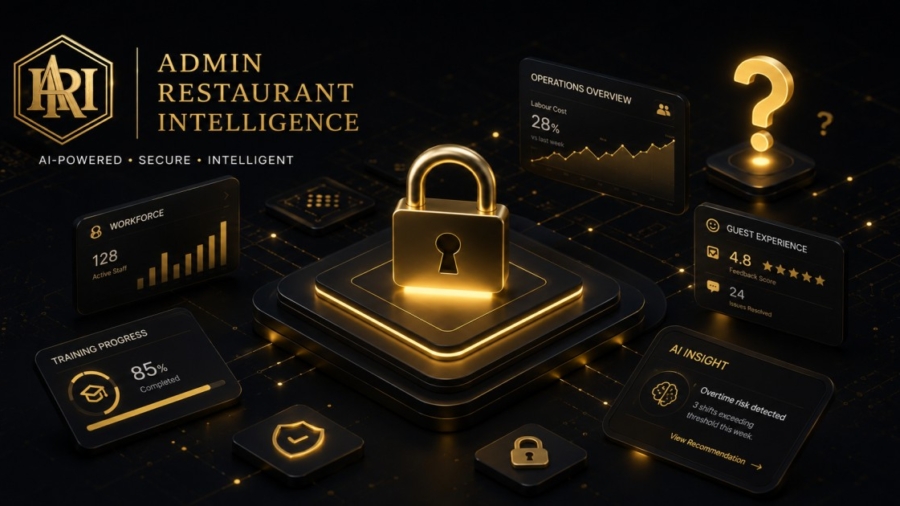
Picture a typical Friday night shift. The kitchen is in the weeds, a server just called in sick, and your manager is trapped in the back office trying to reconcile receipts, fix a broken rota, and answer staff messages on WhatsApp.This is the reality for most hospitality venues. Operators are constantly stitching together disconnected apps for scheduling, payroll, training, and communication. It is a stressful, manual process that drains profits and team morale.But what if a single, intelligent system could handle it all? Enter the Admin Restaurant Intelligence – AI Hospitality Operations PlatformSoftware & Services/Operating Systems. This Admin Restaurant Intelligence – AI Hospitality Operations Platform comprehensive tech suite isn’t just another app; it is a unified brain for your entire hospitality business.
By consolidating your tech stack, this AI-powered platform lets you ditch the chaos of multiple logins and fragmented data. Let’s dive deep into why this operating system is fundamentally changing how restaurants, bars, and hotels operate.
Why Restaurant Operations Are Ready for a Different Approach
Restaurant margins are notoriously sensitive to labour, food costs and operational inefficiencies.
The pressure has increased further as hospitality employers deal with rising pay and operating expenses. UK ONS data showed median monthly pay in accommodation and food services reaching £1,410 in December 2025, while the sector has also experienced employment pressure.
Food waste is another hidden drain. WRAP’s more recent food-waste guidance notes that every kilogram of wasted food can cost a business more than £4 once food, energy, labour and disposal are considered.
Meanwhile, restaurants are increasingly experimenting with AI. Deloitte’s 2025 global restaurant research found that 82% of surveyed restaurant executives planned to increase AI investment, with operations improvement among the major expected benefits. But Deloitte also found that identifying the right use cases and managing AI risks were major barriers.So the question isn’t really whether restaurants will use AI.
The better question is:Will they use AI as another disconnected tool, or as an intelligence layer across the operation?
What Is Admin Restaurant Intelligence, Exactly?
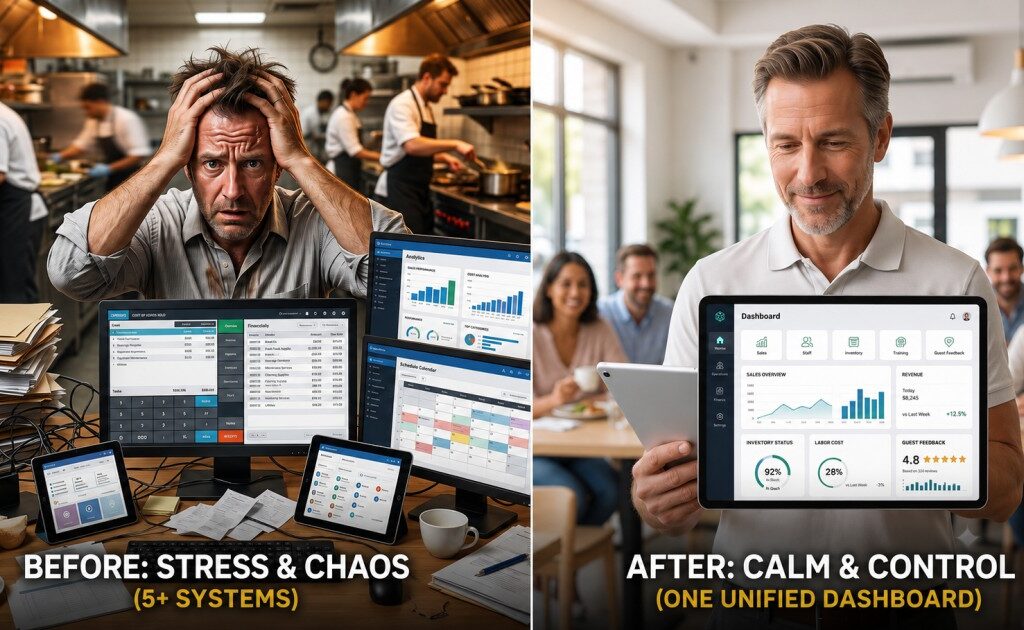
At its core, Admin Restaurant Intelligence is a subscription-based operating system for hospitality venues — restaurants, bars, cafés, and hotels. Instead of stitching together separate apps for scheduling, payroll, and training, everything lives in a single dashboard.
The platform is organized around six functional pillars:
- Workforce management — staff profiles, roles, and team organization in one place
- Training — structured onboarding and an “academy” for tracked upskilling
- Operations — daily checklists, service standards, and real-time team communication
- Finance — payroll calculated with country-aware rules, plus automated receipt capture
- Reporting — performance visibility across teams and, for multi-site operators, across locations
- ARI (the intelligence layer) — pattern-detection across the other five pillars, meant to surface operational risks before they become losses
There’s also a guest-facing feature worth noting: a QR-based digital concierge at each table, letting guests reach staff directly for service recovery or feedback — a small but practical touch that ties guest experience into the same operational picture as staffing and finance.
The “Intelligence” Layer Is the Most Interesting Part
The platform’s AI layer is called ARI, described as a living intelligence that reads across the restaurant’s different operational areas.For example, the platform demonstrates an insight in which labour for a particular period is above target and suggests adjusting a server’s shift timing. It also displays a confidence score and explains the reasoning behind the recommendation.
That’s a much more useful direction for restaurant AI than simply asking a chatbot:
“How can I reduce costs?”
A generic AI can give you 20 suggestions.
An operational AI should ideally be able to say:
“Your Friday 3–6pm staffing is running approximately 8% above the target range. Moving one server later could protect margin without materially affecting service.”
The difference is context.
The first is content generation.
The second is decision support.
And that is where Admin Restaurant Intelligence potentially has its strongest proposition.
How the Platform Connects a Restaurant’s Workflow
One of the clearest ideas on the platform is its employee-to-payroll workflow.A staff member enters the system once, then moves through onboarding, training, rota assignment, attendance, performance and payroll-related processes.
Conceptually, it looks like this:
Employee joins → Training → Rota → Attendance → Performance → Payroll → AI analysis → Recommendation
That creates an important feedback loop.
Traditional software often stores information.
A connected operating system can potentially learn from the information.
For restaurant owners, that could change reporting from something that happens after the week ends into something closer to continuous operational intelligence.
What Does Admin Restaurant Intelligence – AI Hospitality Operations Platform Include?
Workforce and Rota Management
ARI lets managers organize employees, roles, schedules and shifts inside the platform.Its rota tools are designed to show live labour-cost and overtime warnings before a rota is published.That is one of the more practical features in the system.Instead of building the schedule first and discovering the labour bill later, managers can make staffing decisions with cost visibility built into the process.
For a restaurant operating on tight margins, that kind of feedback can potentially be more useful than another analytics dashboard nobody checks.
Attendance and Payroll
Attendance data flows into payroll-related functionality, according to the platform’s documentation.ARI says gross-to-net calculations can be generated from attendance data and applicable jurisdiction rules.The platform also markets itself as UK payroll ready, which is particularly relevant to its UK hospitality positioning.However, this is an area where restaurant owners should do their homework before relying on automation.
Payroll is high-stakes. You should verify that the system supports your specific employment setup, payroll requirements, and accounting workflow before replacing an established payroll process.
Training and Staff Development
Employee training is often treated as a separate function from operations.ARI takes the opposite approach.
Its Training Academy provides structured onboarding and upskilling, while performance tools are designed to identify skill gaps and track progress.This becomes interesting when combined with workforce data.For example, a restaurant could potentially see not just who is scheduled, but whether those employees have completed the training required for particular responsibilities.
That’s much closer to operational intelligence than a standalone training library.
Operations and Daily Checklists
Restaurants depend heavily on repeatable processes.
Opening procedures, closing procedures, food-safety checks, equipment checks, cleaning, service standards and handovers all have to happen consistently.ARI includes operational checklists and communication tools intended to standardize these activities.The advantage here isn’t necessarily sophisticated AI.It’s consistency.
A checklist that is actually connected to the rest of your restaurant data can be more useful than a beautifully designed checklist living in an isolated app.
The AI Layer: What Makes Admin Restaurant Intelligence – AI Hospitality Operations Platform Different?
This is where the product becomes more ambitious.
ARI describes its Operations Brain as an intelligence layer that reads across the venue’s operational information, flags risks and recommends the next best action. The platform says recommendations are explained and only acted upon after confirmation.
There’s also an Intelligence Coach built into the platform.That distinction is important.ARI isn’t simply adding a chatbot to restaurant software.The idea is for AI to analyze signals from different operational areas and help the manager decide what to do next.Imagine a system noticing that labour spending is increasing, overtime is appearing on the rota, and staffing levels don’t match the expected workload.The value isn’t the AI telling you that labour is expensive.The value would be connecting those signals and highlighting the decision that deserves your attention.
That’s the part of ARI’s concept I find most interesting.
Guest Experience and QR Concierge
ARI also includes a guest-facing feature.Customers can scan a table QR code to reach the restaurant team digitally, with support for service recovery and feedback.This could reduce friction when a guest needs help but doesn’t want to wait for a server to pass by.More importantly, it potentially connects guest feedback with operational data.
That could eventually allow restaurant owners to see relationships between staffing, service issues and customer experience rather than treating feedback as isolated comments.
How Much Does Admin Restaurant Intelligence – AI Hospitality Operations Platform Cost?
This is where the platform separates itself from most consumer software.The current offer is:£350 per month
That price includes VAT at checkout, is charged monthly, and can be cancelled at any time. The offer includes every feature and unlimited staff accounts, with no feature tiers or per-user pricing.
| Feature | Included? |
|---|---|
| Workforce Management | YES |
| Rotas & Scheduling | YES |
| Attendance | YES |
| Training Academy | YES |
| Operations & Checklists | YES |
| Payroll | YES |
| Receipt Intelligence | YES |
| Reporting | YES |
| AI Intelligence | YES |
| Guest QR Concierge | YES |
| Unlimited Staff | YES |
| Feature Add-ons | NO |
| Monthly Contract | NO |
At first glance, £350/month sounds expensive.But the comparison becomes more interesting if a restaurant is currently paying for five different systems.ARI says its platform replaces the need for separate rota, training, payroll, communication and reporting tools with a single system.
So the right calculation isn’t simply:
“Is £350 expensive?”
It’s:
“How much am I currently spending on software, administration and management time?”
The Traditional Chaos vs. The Modern Operating System
For years, the standard approach to restaurant management has been a patchwork solution. You buy a tool for scheduling, another for payroll, and maybe a third for staff training.
The problem? These systems do not talk to each other. Your labor costs sit in one app, your sales data in another, and your compliance checklists on a physical clipboard.
Admin Restaurant Intelligence – AI Hospitality Operations Platform (ARI) eliminates this fragmentation. It acts as a central operating system, unifying every critical function.
A Direct Comparison of Operations
Here is a look at how the traditional model stacks up against the unified approach of ARI:
| Feature/Function | The Traditional “Patchwork” Method | The Admin Restaurant Intelligence Way |
| Tech Stack | 5+ different apps (Rota, HR, Payroll, Comms) | 1 unified platform with a single login |
| Data Visibility | Disconnected data; requires manual spreadsheet exports | Connected operational data with real-time AI insights |
| Staff Training | Boring manuals, disconnected video courses | Automated, role-based, game-style learning modules |
| Pricing Model | Multiple subscriptions with hidden per-user fees | Flat £350/month, unlimited staff, all modules included |
| Actionable Insights | Looking backwards at historical data | AI reads across domains to recommend the “next best action” |
Admin Restaurant Intelligence Security and Data Privacy
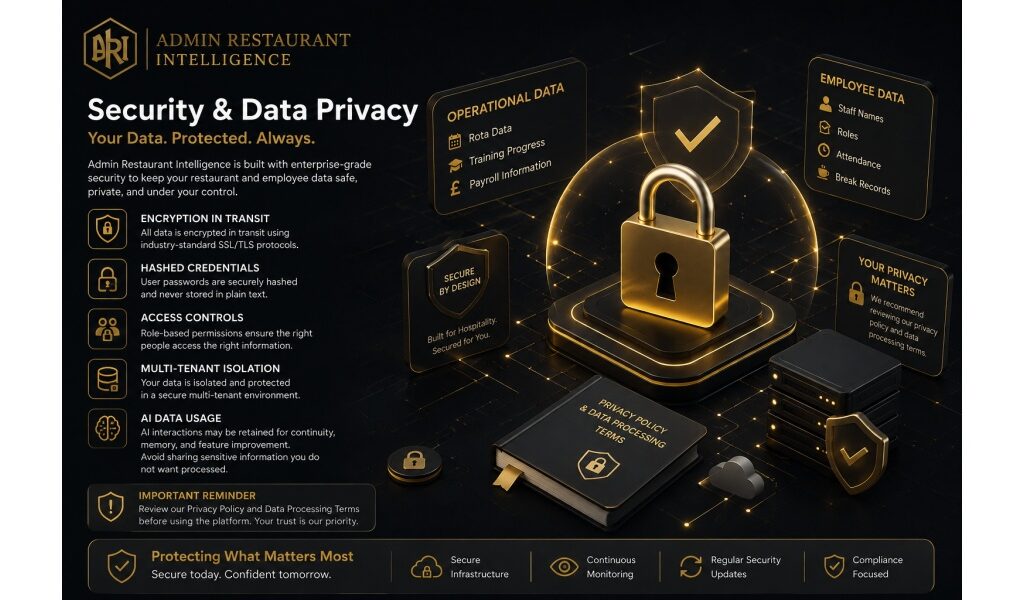
This is an area that deserves attention because ARI can process employee and operational information.Its current privacy policy says restaurant customers may submit staff names, roles, training progress, attendance, break records, rota data and payroll-related figures.ARI says it uses encryption in transit, hashed credentials, access controls and multi-tenant isolation. It also says its AI interactions can be retained for continuity, memory and feature improvement.That last point is important.
Restaurant operators should understand what information is being entered into AI features before making the platform part of their everyday workflow.The company specifically advises users not to submit information they do not want processed for those purposes.
For a business handling employee and payroll data, reviewing the provider’s privacy policy and data-processing terms should be part of the buying process—not an afterthought.
One Thing I Would Watch Carefully
There’s a reason I’m more cautious about this product than I would be with an established software giant.ARI’s current privacy policy states that its operating company is in the process of incorporation in England and Wales, with the company registration number and registered office to be published once available.That doesn’t automatically make the product bad.But it does mean potential customers should distinguish between an interesting new platform and a long-established enterprise software company with years of operating history.
The public demo documentation also states that demo data may be fictional and that demo features can differ from the production platform.
That makes the free demonstration useful for understanding the interface—but not sufficient evidence of production performance.
How It Stacks Up Against Established Players
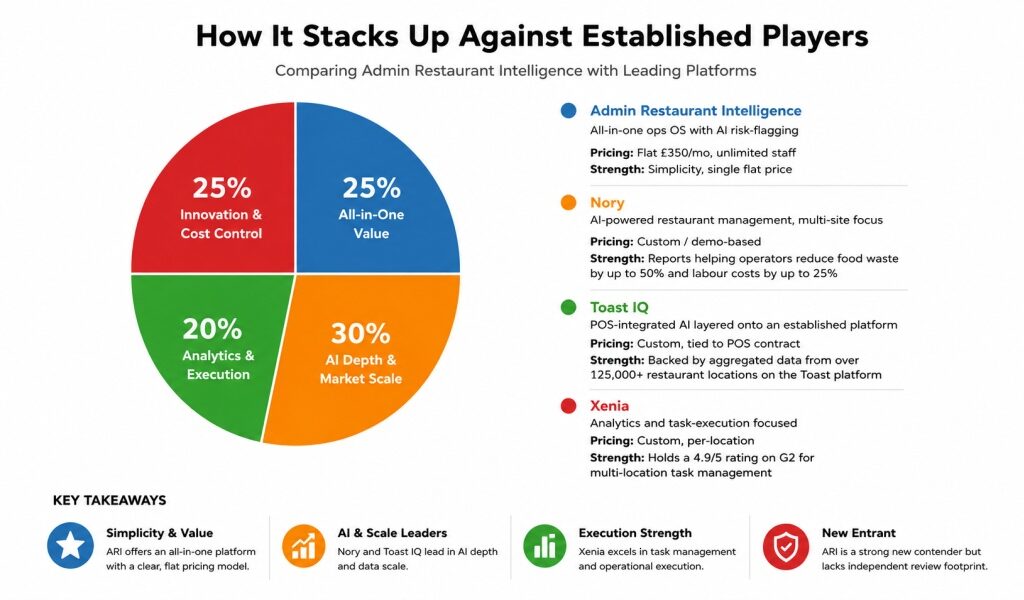
Admin Restaurant Intelligence is entering a market that already has some serious incumbents. Here’s roughly where it sits:
| Platform | Positioning | Pricing Model | Notable Strength |
|---|---|---|---|
| Admin Restaurant Intelligence | All-in-one ops OS with AI risk-flagging | Flat £350/mo, unlimited staff | Simplicity, single flat price |
| Nory | AI-powered restaurant management, multi-site focus | Custom/demo-based | Reports helping operators reduce food waste by up to 50% and labour costs by up to 25% |
| Toast IQ | POS-integrated AI layered onto an established platform | Custom, tied to POS contract | Backed by aggregated data from over 125,000 restaurant locations on the Toast platform |
| Xenia | Analytics and task-execution focused | Custom, per-location | Holds a 4.9/5 rating on G2 for multi-location task management |
The honest takeaway: the established names have years of public reviews, case studies, and third-party ratings behind them. Admin Restaurant Intelligence, by contrast, is a newer entrant — at the time of writing, it doesn’t yet have the independent review footprint (Trustpilot, G2, Capterra) that lets you cross-check the marketing claims against real customer experiences. That’s not a dealbreaker, but it does mean your due diligence has to work harder.
Where This Kind of Platform Genuinely Helps
Setting the specific vendor aside for a second, the broader shift ARI is riding is real. Industry coverage notes that AI in hospitality is moving from individual point tools toward connected systems spanning payments, reservations, workforce management, and back-of-house operations, with the technology increasingly shaping decisions rather than just supporting them.
The sensible way most operators are using this shift, according to product leaders in the space, is as a decision-support layer rather than an autopilot. As one hospitality tech director put it, the goal is a “human in the middle” approach, where AI outputs are presented as options or recommendations backed by data, rather than final decisions. That’s a useful lens to apply to ARI’s “intelligence” claims too — treat the flagged risks and insights as a second opinion, not gospel, at least until you’ve watched the system operate against your own numbers for a few months.
Who Should Actually Consider Admin Restaurant Intelligence
Given the flat pricing and unlimited-staff structure, this platform makes the most sense for:
- Single-site independents with growing headcount who are outgrowing spreadsheets but don’t want per-user pricing that punishes them for hiring
- Operators tired of tool sprawl who’d rather pay one predictable bill than five subscriptions that don’t talk to each other
- Teams that value simplicity over customization — since there’s no tiered feature-gating, you’re not spending time deciding what to upgrade
It’s a harder sell for:
- Multi-location groups who need dedicated cross-site benchmarking that mature competitors have spent years refining
- Highly price-sensitive independents for whom £350/month (£4,200/year) is a significant fixed cost relative to revenue
- Buyers who lean heavily on peer reviews before committing, since the independent review trail here is thin right now
The Bottom Line
Admin Restaurant Intelligence is making a genuinely appealing promise: one platform, one flat price, everything included, no feature-gating games. If you’re drowning in disconnected tools and the idea of a single operational dashboard sounds like relief, it’s worth taking the “Experience the Platform” walkthrough before you commit — precisely because there isn’t yet a deep bench of independent reviews to lean on.
The smartest move with any new hospitality platform, this one included, is to treat the walkthrough as due diligence, not a formality. Ask specifically how the “intelligence” flags are generated, request references from current users if any exist, and compare the total annual cost against what you’re currently spending across your separate tools before you sign up for a recurring charge.
Your Next Step
If your restaurant’s operations are held together by spreadsheets and group chats, it might genuinely be time to consolidate. Take the guided walkthrough, ask hard questions about the AI layer, and run the numbers against your current tool stack before committing to any monthly platform — Admin Restaurant Intelligence included.
Have you tried Admin Restaurant Intelligence or a similar all-in-one hospitality platform? Share your experience in the comments — and if you’re still comparing options, check out our other restaurant management software breakdowns before you decide.
Ready to explore it? Take a closer look at Admin Restaurant Intelligence, compare its features with the tools you’re already using, and decide whether bringing your restaurant’s operations into one intelligent platform makes sense for your business.