
Introduction: What Should You Know About Audifort Side Effects?
When a supplement promises to support hearing health, mental clarity and overall well-being, it is natural to wonder whether the potential benefits outweigh the risks.
Audifort is a liquid dietary supplement marketed for hearing and brain wellness. Its promotional material highlights a multi-ingredient formula and suggests that it may support people concerned about ringing in their ears, hearing changes and related issues.But before purchasing any health supplement, two important questions deserve attention: What are the possible Audifort side effects, and is Audifort FDA approved?
These questions matter because a product being sold online does not automatically mean its advertised benefits have been clinically established or that its safety has been independently confirmed.In this guide, we examine Audifort’s advertised ingredients, the limitations of the available product-specific safety evidence, FDA regulations for dietary supplements, and the precautions worth considering before use.
If you are researching Audifort before buying it, this article will help you understand what is known, what remains uncertain, and which questions you should ask.
Is Audifort FDA Approved?
This is one of the most important questions to address.The U.S. Food and Drug Administration (FDA) regulates dietary supplements, but its regulatory approach differs from the approval process for prescription medicines.
According to the FDA’s official guidance on dietary supplements, the agency does not approve dietary supplements for safety and effectiveness before they are marketed.Consequently, a supplement can be legally sold without having undergone the same premarket clinical evaluation required for a new prescription medicine.
What Does This Mean for Audifort?
Audifort is marketed as a dietary supplement. Therefore, consumers should not assume that the FDA has independently verified its advertised hearing benefits or established its effectiveness through clinical trials.
There is an important distinction between the following terms:
| Term | What it actually means |
|---|---|
| FDA approved | The FDA has formally approved a product for a particular use under the applicable regulatory process. |
| FDA registered | A facility or entity has completed a relevant registration process. Registration does not mean the product itself has been approved. |
| Manufactured under applicable quality requirements | The manufacturer is subject to relevant manufacturing and quality requirements. This does not establish clinical effectiveness. |
| Clinically proven | Appropriate clinical evidence supports a specific claim about a product or treatment. The strength of that evidence depends on the quality of the studies. |
These terms are not interchangeable.
Our finding: We could not verify product-specific FDA approval for Audifort from the information reviewed. More importantly, dietary supplements generally do not receive FDA approval for safety and effectiveness before marketing.
For additional information, read the FDA’s explanation of how dietary supplements are regulated.
What Are the Possible Audifort Side Effects?
One challenge when researching Audifort side effects is distinguishing documented adverse reactions from general precautions associated with dietary supplements.
The product information reviewed for this article does not provide sufficient independently verified, product-specific clinical evidence to establish a reliable list of Audifort side effects or determine how frequently they occur.
That does not prove the supplement is free from side effects. It means consumers should avoid treating the absence of documented information as proof of safety.
1. Digestive Discomfort
Some dietary supplements can cause digestive symptoms, depending on their ingredients, concentrations and the person taking them.However, we cannot confidently identify digestive discomfort as a confirmed or common Audifort side effect without reliable product-specific evidence.
If you experience persistent nausea, abdominal discomfort, vomiting or other concerning symptoms after taking a supplement, stop using it and seek appropriate medical advice.
2. Allergic Reactions or Sensitivities
Multi-ingredient supplements may contain botanical extracts or other substances that are unsuitable for certain individuals.Review the complete ingredient label before use, particularly if you have known allergies or sensitivities.
Seek emergency medical assistance if you experience symptoms of a serious allergic reaction, such as difficulty breathing or swelling of the tongue or throat.
3. Possible Medication Interactions
Herbal ingredients and other dietary supplement components can interact with prescription medicines or other supplements.
The potential interaction depends on the exact ingredients, their amounts and the medicines involved.The FDA advises consumers to consult a healthcare professional before using dietary supplements when appropriate. Its guidance on mixing medicines and dietary supplements explains why these interactions deserve attention.
4. Unknown Long-Term Effects
A supplement’s long-term safety cannot be established simply by looking at its ingredient list.Reliable assessment requires information about the complete formula, ingredient quantities, duration of use and relevant safety evidence.If you cannot obtain a complete and clear product label, consider discussing the uncertainty with a qualified healthcare professional before deciding whether to use it.
Important: These are general supplement safety considerations, not a list of confirmed Audifort adverse effects. Product-specific risks and their frequency remain uncertain based on the evidence identified for this review.
What Ingredients Does Audifort Contain?
According to the product information examined in our previous Audifort review, the seller highlights multiple ingredients, including maca root, grape seed extract, green tea, capsicum, Gymnema sylvestre and GABA.
The precise composition and quantity of every ingredient should be checked against the product’s current Supplement Facts label.
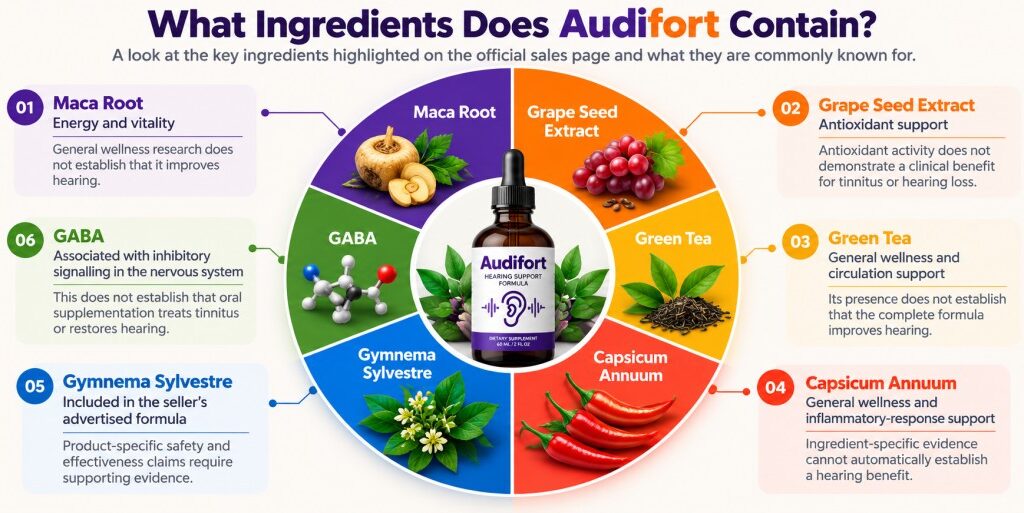
| Ingredient | Advertised or commonly discussed purpose | What consumers should know |
|---|---|---|
| Maca root | Energy and vitality | General wellness research does not establish that it improves hearing. |
| Grape seed extract | Antioxidant support | Antioxidant activity does not demonstrate a clinical benefit for tinnitus or hearing loss. |
| Green tea | General wellness and circulation support | Its presence does not establish that the complete formula improves hearing. |
| Capsicum annuum | General wellness and inflammatory-response support | Ingredient-specific evidence cannot automatically establish a hearing benefit. |
| Gymnema sylvestre | Included in the seller’s advertised formula | Product-specific safety and effectiveness claims require supporting evidence. |
| GABA | Associated with inhibitory signalling in the nervous system | This does not establish that oral supplementation treats tinnitus or restores hearing. |
This table summarizes the seller’s ingredient descriptions and general evidence limitations. It is not a complete ingredient label or a clinical assessment of Audifort.
Why the Complete Formula Matters
An ingredient may have been studied in laboratory experiments or human research, but that does not mean a finished supplement containing it will produce the same results.
Three factors are particularly important:
- Dosage: The quantity in the product must be compared with the amount studied in relevant research.
- Formula: Ingredients can behave differently when combined, and evidence for one ingredient does not establish the effectiveness of the complete mixture.
- Clinical evidence: Research needs to measure meaningful outcomes in people, using appropriate methods.
Before buying Audifort, examine the full label and look for ingredient quantities, serving instructions and manufacturer information.
If these details are unavailable or unclear, evaluating the product’s potential benefits and risks becomes more difficult.
Can Audifort Interact With Medications?
This is a relevant question for anyone considering a multi-ingredient supplement.
Some dietary supplement ingredients can affect how medicines work, alter their effects or increase the risk of adverse reactions.
The possibility of an interaction depends on the actual formula and the individual’s circumstances. Without a verified, complete ingredient list and appropriate interaction data, it would be misleading to declare Audifort compatible with every medication.
Before using Audifort, speak with a doctor or pharmacist if you:
- Take prescription medicines regularly.
- Use other dietary supplements or herbal products.
- Have an ongoing medical condition.
- Have a history of allergic reactions to supplements.
- Are pregnant, breastfeeding or considering using the product in these circumstances.
Bring the complete product label to the consultation so the healthcare professional can review the ingredients and amounts.
Do not stop prescribed medication or change its dosage to accommodate a supplement without professional guidance.
Is Audifort Safe to Take Every Day?
There is no reliable basis in the evidence reviewed here to establish a universally safe daily regimen for Audifort.
The appropriate decision depends on the product’s actual composition, its directions, the person’s health and any medications they take.
Before considering daily use, check the following:
1. Read the complete label. Confirm the serving size, ingredient amounts and recommended directions.
2. Check the manufacturer information. Look for identifiable manufacturer or distributor details and relevant quality information.
3. Review potential interactions. Ask a qualified healthcare professional whether the ingredients are appropriate for you.
4. Understand the evidence limitations. A seller’s suggested usage period does not prove that taking the supplement for that duration will improve hearing or remain safe for every user.
5. Monitor unexpected symptoms. Stop using the product and seek appropriate medical advice if you develop concerning symptoms.
A supplement should not replace medical evaluation when hearing problems or persistent tinnitus are present.
Does Audifort Help With Tinnitus or Hearing Loss?
Safety and effectiveness are different questions, but both matter when evaluating a hearing supplement.
Tinnitus is the perception of sounds such as ringing or buzzing without an external sound source. It can be associated with hearing loss, noise exposure, certain medications and other factors.
The National Institute on Deafness and Other Communication Disorders explains that vitamins, herbal extracts and dietary supplements marketed for tinnitus have not been proven effective for treating the condition.
Our previous Audifort review also found no verifiable published clinical trial demonstrating that Audifort itself improves hearing or reduces tinnitus. Pasted markdown
That distinction is important: evidence about an individual ingredient does not establish that the complete Audifort formula works.
What Are the Established Alternatives?
Depending on the cause and severity of the problem, appropriate hearing care may involve:
- A professional hearing assessment.
- Hearing aids for people with suitable hearing loss.
- Sound-based approaches for managing tinnitus.
- Cognitive behavioural therapy to reduce tinnitus-related distress.
- Protection from excessive noise exposure.
The American Academy of Otolaryngology–Head and Neck Surgery Foundation’s tinnitus guidance discusses evidence-based management options and recommends against routinely using dietary supplements to treat tinnitus.
Seek urgent medical evaluation for sudden hearing loss. Do not wait to see whether a supplement helps, because prompt assessment can be important for treatment.
How Much Does Audifort Cost, and Is It Worth Buying?
The Audifort offer information reviewed for our previous article displayed packages priced at $158, $177 and $294, depending on the supply selected. The seller also advertised a 90-day money-back guarantee. These details may change, so check the current offer page for the latest prices, shipping charges and refund conditions. Pasted markdown
Price alone does not determine whether a supplement is worthwhile.
Before spending money, consider whether the advertised benefits are supported by reliable evidence, whether the complete formula is disclosed, and whether you have enough safety information to make an informed decision.
A larger package may reduce the advertised cost per bottle, but it does not make the supplement more effective or establish that long-term use is appropriate.
For a broader assessment of the seller’s claims, pricing and scientific evidence, see our complete Audifort review.
Frequently Asked Questions About Audifort
Is Audifort FDA approved?
We could not verify product-specific FDA approval from the information reviewed. More generally, the FDA does not approve dietary supplements for safety and effectiveness before they are marketed.
What are the side effects of Audifort?
The evidence reviewed does not establish a reliable list or frequency of Audifort-specific side effects. General supplement concerns include possible allergic reactions, ingredient-related adverse effects and medication interactions.
Is Audifort safe to take every day?
Its safety for every individual and for long-term daily use has not been established by the evidence reviewed. Check the full label and consult a qualified healthcare professional before use.
Can Audifort interact with prescription medicines?
Potential interactions depend on the actual ingredients, quantities and medicines involved. Ask a doctor or pharmacist to review the complete product label.
Does Audifort cure tinnitus?
There is no verifiable clinical evidence identified for this review establishing that Audifort cures tinnitus. The NIDCD also states that dietary supplements marketed for tinnitus have not been proven effective for treating the condition.
Is Audifort clinically proven?
We could not identify a verifiable published clinical trial establishing the effectiveness of Audifort itself for improving hearing or reducing tinnitus.
Final Verdict: Should You Be Concerned About Audifort Side Effects?
Audifort is marketed as a hearing and brain wellness supplement, but several important questions remain unanswered.
The evidence reviewed does not establish a reliable list of Audifort-specific side effects, prove that the product is safe for everyone, or demonstrate that it improves hearing or treats tinnitus.
Its FDA status also needs to be understood correctly: dietary supplements generally do not receive FDA approval for safety and effectiveness before marketing. This does not, by itself, establish that a particular supplement is unsafe; it means consumers should not interpret its availability as proof of FDA approval.
Before considering Audifort, review the complete ingredient label, check the seller’s current information, consider potential medication interactions and speak with a qualified healthcare professional when appropriate.
Most importantly, do not rely on a supplement instead of getting hearing symptoms assessed.
Final Thoughts
When evaluating a health product, the most useful questions are not simply whether it is popular or whether other customers report positive experiences. What matters is whether the claims are supported by reliable evidence, whether the risks are understood and whether the product is appropriate for the individual.
We hope this guide has helped clarify the questions surrounding Audifort side effects and FDA approval.
Want to examine the product’s claims in more detail? Read our Audifort Review (2026): Does Audifort Really Work? for a broader analysis of its advertised benefits, ingredients, clinical evidence and pricing.
You can also visit the Audifort offer page to check the seller’s current product information and terms. Review those details carefully before making a purchase.
This article is for informational purposes only and is not a substitute for professional medical advice, diagnosis or treatment.