
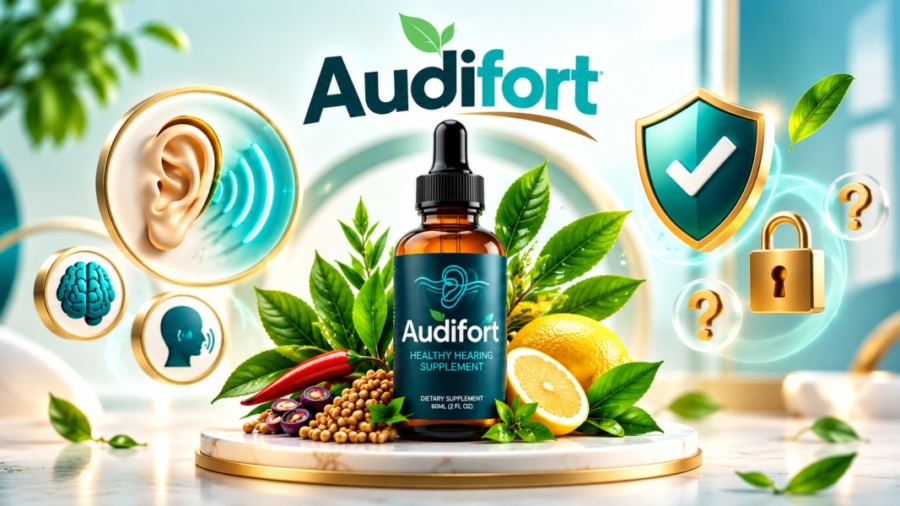
Search for Audifort and you’ll find hundreds of glowing reviews. Dig a little deeper and something strange happens: many of them read almost word for word alike, and a few are hosted on university and conference websites that have nothing to do with hearing health. One even asks whether Audifort “really works for weight loss.” It’s a hearing product.
So before you hand over $158 to $294, it’s worth asking the question those pages avoid: does Audifort really work, or is it just very well marketed? Here’s what the official order page says, what the clinical evidence says, and where the two don’t line up.
What Is Audifort?
Audifort is a liquid supplement promoted for hearing support and cognitive wellness. According to its official sales page, the formula contains more than 20 selected ingredients intended to support healthy hearing and general well-being.
The product’s marketing discusses several concerns, including ringing or buzzing in the ears, mental fog, memory, and age-related hearing concerns.
However, it’s important to distinguish between supporting general health and treating a medical condition. A supplement marketed for ear health has not necessarily been shown to reduce tinnitus, restore damaged hearing, or prevent hearing loss.
The U.S. Food and Drug Administration explains that dietary supplements are not approved for safety and effectiveness before marketing in the same way as prescription medicines. Manufacturers remain responsible for product safety, labeling, and ensuring that claims are lawful and truthful. (FDA guidance on dietary supplements)
That distinction matters when evaluating any supplement making health-related promises.
Audifort Ingredients: What’s Inside the Formula?
Audifort’s sales page highlights several ingredients. Understanding what these ingredients are—and what remains unproven—provides a better starting point than relying on promotional descriptions alone.
| Ingredient | Purpose stated by the seller | What to consider |
| Maca root | Energy and vitality | Evidence for general wellness does not establish a benefit for hearing loss. |
| Grape seed extract | Antioxidant support | Antioxidant activity does not prove that a supplement improves hearing. |
| Green tea | Circulation support | A proposed mechanism is not proof of a clinical hearing benefit. |
| Capsicum annuum | Healthy inflammatory response | Evidence for a general biological effect does not establish effectiveness for tinnitus. |
| Gymnema sylvestre | Hearing support | Product-specific clinical evidence is needed to substantiate this claim. |
| GABA | Relaxation support | A relaxation-related claim does not demonstrate that the ingredient treats tinnitus or restores hearing. |
Source for the listed ingredients: Audifort’s product page. The benefit descriptions above distinguish the seller’s positioning from independently established clinical outcomes.
Why Ingredient Lists Can Be Misleading
An ingredient may have antioxidant properties, influence a biological process, or have been studied for a particular health outcome. That does not automatically mean a finished supplement containing it produces the advertised result.
Three things matter:
- Dosage: The amount used in a clinical study needs to be compared with the amount supplied by the product.
- Formula: Evidence for an individual ingredient cannot automatically be transferred to a mixture of more than 20 ingredients.
- Clinical outcomes: Improvements need to be measured in people using reliable methods, rather than inferred from laboratory findings or testimonials.
Before buying Audifort, check the complete Supplement Facts label, including the amounts per serving. If those amounts are unclear, it becomes difficult to assess whether the formula resembles the quantities studied in research.
Does Audifort Really Work? What the Evidence Says
Here’s the honest answer: there’s no published clinical trial showing that Audifort itself improves hearing or reduces tinnitus. The order page cites general research instead, and that’s not the same thing. But we can still look at what’s known about this entire category of product.
Hearing and Tinnitus Supplements Have a Weak Track Record
Several third-party reviews list ginkgo biloba as a key Audifort ingredient. I couldn’t confirm that from the official page text, which highlights different ingredients, so check the bottle label yourself. Either way, ginkgo is the most studied supplement for tinnitus, and the results are a useful reality check.
A Cochrane systematic review of four studies with 1,543 participants found no evidence that ginkgo biloba is effective for tinnitus as a primary complaint. The authors also noted a strong placebo effect in tinnitus management, which helps explain why anecdotal reviews can sound so convincing.
What Professional Guidelines Say
The American Academy of Otolaryngology–Head and Neck Surgery Foundation’s tinnitus guideline says clinicians should not recommend ginkgo biloba, melatonin, zinc, or other dietary supplements for persistent, bothersome tinnitus. Instead, it advises cognitive behavioral therapy for people whose tinnitus is distressing.
One more structural point: as an audiology resource explains, the FDA treats supplements as food, so manufacturers don’t have to prove their claims before selling. Regulators generally act after problems are reported.
The Order Page’s “Scientific References”
I read the reference list on the order page. Some entries are legitimate, such as a piece on animal research into tinnitus and the brain, and a review of B vitamins and brain function. But legitimate studies about the brain or individual nutrients don’t show that this specific formula works.
Two entries stood out: A Course in Miracles, a spiritual text, and a paper on medicinal plants used for gastrointestinal disorders in an Iranian region. Neither has anything to do with hearing. When a reference list pads itself like this, treat the other claims with extra skepticism.
What Research Says About Hearing Supplements
The National Institute on Deafness and Other Communication Disorders (NIDCD) explains that tinnitus can be associated with hearing loss, noise exposure, and certain medications, among other factors. It also states that commonly advertised vitamins, herbal extracts, and dietary supplements have not been proven effective for tinnitus.
A peer-reviewed clinical guideline on chronic tinnitus likewise recommends against dietary supplements as an established treatment because convincing evidence of efficacy is lacking. (Clinical guideline on chronic tinnitus)
The practical takeaway is straightforward: the presence of natural ingredients or a plausible biological explanation is not enough to show that Audifort works.
To establish effectiveness, researchers would need to study the actual product using appropriate clinical methods and report meaningful outcomes, such as validated tinnitus symptom scores or standardized hearing tests.
What About Customer Testimonials?
Audifort’s sales page features customer reviews describing perceived benefits. These may reflect genuine individual experiences, but testimonials cannot establish whether the supplement caused an improvement.
Tinnitus symptoms can fluctuate naturally, and expectations, changes in sleep, stress, other treatments, and differences in how symptoms are perceived can all affect an individual’s experience.
A testimonial is therefore best understood as an individual’s account, not a substitute for a controlled clinical study.
Audifort vs Evidence-Based Hearing Care
Rather than judging Audifort in isolation, it helps to compare the supplement approach with established ways of assessing and managing hearing concerns.
| Approach | Main purpose | Evidence and limitations |
|---|---|---|
| Audifort | Supplement marketed for hearing and brain wellness | Product-specific hearing benefits have not been established by verifiable clinical evidence identified for this review. |
| Hearing assessment | Identify hearing changes and possible causes | Helps guide appropriate care and determine whether hearing loss is present. |
| Hearing aids | Improve access to sound for eligible people with hearing loss | An established option for managing hearing difficulties. |
| Tinnitus support | Reduce the impact of ringing or buzzing | Options can include sound therapy and cognitive behavioural therapy, depending on the person. |
| Hearing protection | Reduce exposure to damaging noise | Helps prevent noise-induced hearing loss. |
The NIDCD’s tinnitus treatment guidance explains that management depends on the underlying cause and may involve hearing aids, sound-based approaches, or behavioural therapy.
The right option depends on the problem. A dietary supplement should not be assumed to provide the same benefits as a hearing assessment or an established treatment.
Potential Benefits: What Can You Realistically Expect?
Audifort is marketed as a convenient liquid supplement containing multiple ingredients. Some potential considerations for a consumer include:
- Convenience: A liquid format may appeal to someone who prefers not to swallow tablets.
- Multiple ingredients: The formula combines several ingredients rather than relying on a single nutrient.
- Simple routine: A supplement may be straightforward to incorporate into an existing routine, provided it is suitable for the individual.
However, these are practical product characteristics, not proof of improved hearing.
There is currently insufficient product-specific evidence identified in this review to estimate how likely a user is to experience a measurable hearing improvement, how large that improvement might be, or how long it would take.
Be cautious of claims promising rapid results, restored hearing, or guaranteed relief from ringing. Those outcomes require robust evidence.
Is Audifort Safe?
“Natural” does not automatically mean safe for everyone.
The product contains multiple ingredients, and the appropriate safety assessment depends on their quantities, the finished formula, the person’s medical history, and any medicines they take.
Before using Audifort, consider the following:
- Medication interactions: Herbal extracts and other supplement ingredients can interact with medicines.
- Existing conditions: People with ongoing medical conditions should seek advice from a qualified healthcare professional.
- Allergies and sensitivities: Review the complete label for ingredients that may be unsuitable.
- Pregnancy or breastfeeding: Obtain professional advice before using a multi-ingredient supplement.
- Product transparency: Verify the serving size, ingredient quantities, manufacturer details, and applicable quality information.
The FDA advises consumers to discuss supplements with a doctor, pharmacist, or other qualified healthcare professional before use when appropriate. Its guidance on mixing medicines and supplements explains why interactions deserve attention.
An Important Hearing Health Warning
Do not use Audifort as a reason to delay medical care.
A sudden change or loss of hearing, particularly over a few hours or days, requires urgent medical evaluation. The NIDCD describes sudden sensorineural hearing loss as a medical emergency because delaying assessment and treatment can reduce the chance of recovery. (NIDCD: Sudden Deafness)
Persistent tinnitus, especially when accompanied by other symptoms, also deserves professional assessment.
Audifort Pricing and Money-Back Guarantee
Audifort’s sales page offers different bundle sizes, with the advertised per-bottle price varying according to the package selected.
At the time of research, the page displayed these offers:
| Package | Advertised total | Additional details |
|---|---|---|
| 60-day supply | $158 | Shipping charged separately |
| 90-day supply | $177 | Free US shipping advertised |
| 180-day supply | $294 | Free US shipping and two digital bonuses advertised |
The seller also advertises a 90-day money-back guarantee. These offers, shipping terms, and prices may change, so confirm the final cost and refund conditions at checkout. (Check the current Audifort offer)
Before choosing a large bundle, consider whether you are comfortable with the price and whether you have enough information to assess the product’s suitability. A longer supply does not make a supplement more scientifically effective.
Pros and Cons of Audifort
| Pros | Cons |
|---|---|
| Convenient liquid format | Product-specific clinical efficacy remains unestablished |
| Multiple listed ingredients | Exact ingredient quantities need careful review |
| Several package options | Larger bundles require more upfront spending |
| Advertised money-back guarantee | Refund terms must be checked before purchase |
| Straightforward online ordering | Testimonials are not proof of medical effectiveness |
This balance matters because a product can be convenient and well marketed without having established clinical benefits for the condition it targets.
Who Should Consider Audifort?
Audifort may interest adults researching supplements marketed for hearing wellness who want to examine a multi-ingredient formula.
However, it should not be treated as a proven solution for tinnitus, hearing loss, memory problems, or any other medical condition. Anyone considering it should review the label, discuss potential risks with a qualified healthcare professional, and understand that its product-specific benefits have not been established by the evidence identified for this review.
People seeking help for hearing difficulties should prioritize identifying the cause and exploring appropriate care.
Final Verdict: Is Audifort Worth It in 2026?
Audifort is a hearing-wellness supplement with claims that deserve careful scrutiny.
Its liquid format and multi-ingredient formula may appeal to some consumers, and the seller offers different bundles alongside a stated money-back guarantee. But these features do not answer the most important question: does Audifort reliably improve hearing or reduce tinnitus?
Based on the publicly available information reviewed here, that benefit has not been established by verifiable clinical evidence specific to the product. Wider evidence also does not support assuming that dietary supplements are effective tinnitus treatments simply because they contain botanical or antioxidant ingredients.
Our recommendation is to approach Audifort with realistic expectations. Read the complete label, verify the current price and refund conditions, consider potential interactions, and speak with a qualified healthcare professional before using it for a hearing concern.
Final Thoughts
Your hearing is too important to rely on marketing claims alone. We hope this Audifort review has helped you distinguish the seller’s promises from what scientific evidence currently supports. Explore our other health-product reviews for more balanced assessments, and consult qualified healthcare professionals when making decisions about hearing health.
Want to know more about the ingredients, potential risks, and safety concerns? Read our detailed guide to Audifort Side Effects & FDA Approval: Is It Safe? (2026) before deciding whether this supplement is right for you.
Interested in reviewing the product details? You can visit the Audifort offer page here to check the current ingredient information, package options, price, and refund terms. Remember that purchasing the supplement is not a substitute for appropriate medical evaluation or treatment.